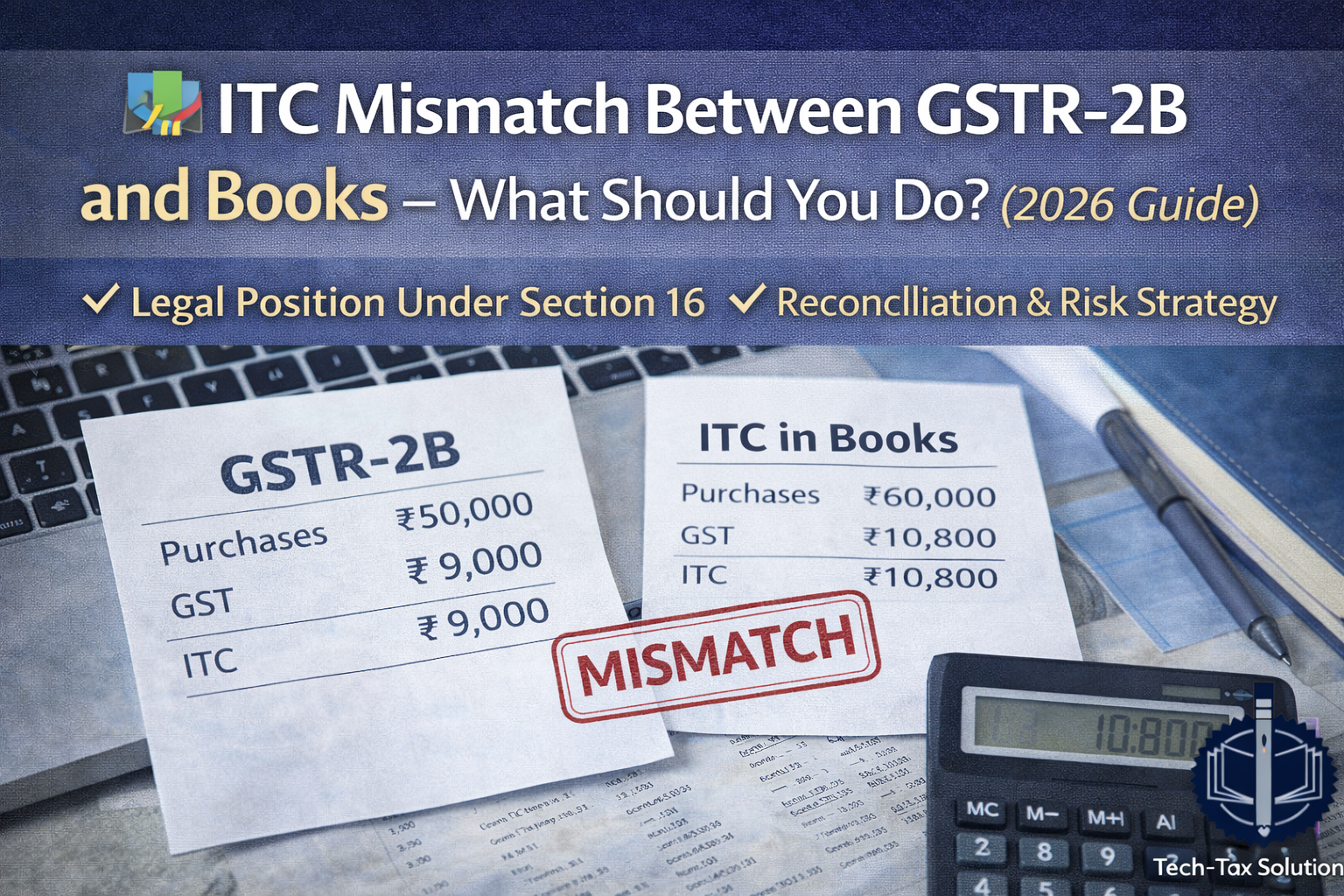
📌 Why ITC Mismatch Is a Serious Issue
One of the most common GST problems today is:
“ITC as per books does not match with GSTR-2B.”
This mismatch can lead to:
-
ASMT-10 scrutiny notice
-
DRC-01 demand notice
-
Interest under Section 50
-
ITC reversal pressure
Understanding the legal position is critical before taking action.
⚖️ Legal Position – Section 16 of CGST Act
As per Section 16(2) of the CGST Act, ITC is available only if:
✔ Tax invoice is available
✔ Goods/services received
✔ Tax paid by supplier
✔ Return filed
Further, Rule 36(4) and 2B mechanism link ITC eligibility with supplier reporting.
Hence, 2B reconciliation is now compliance necessity.
🔍 Common Reasons for 2B vs Books Mismatch
1️⃣ Supplier has not filed GSTR-1
2️⃣ Supplier filed but reported wrong GSTIN
3️⃣ Timing difference (invoice of March reflected in April 2B)
4️⃣ Debit/Credit note mismatch
5️⃣ ITC claimed on ineligible invoices
Not all mismatches mean ineligible credit.
🧠 3 Practical Scenarios
🟢 Scenario 1: Supplier Filed GSTR-1 Late
You purchased goods in March. Supplier files GSTR-1 in April.
Invoice appears in April 2B.
✔ ITC can be claimed in April return.
❌ No need to reverse permanently.
Timing difference must be understood.
🟢 Scenario 2: Supplier Not Filing Returns
Invoice in books but not appearing in 2B for months.
⚠ Risk: ITC may be disputed.
Practical Strategy:
-
Follow up with supplier
-
Maintain communication evidence
-
Evaluate vendor reliability
-
Consider commercial safeguards
🟢 Scenario 3: ITC Claimed on Blocked Credit
Invoice appears in 2B, but ITC is blocked under Section 17(5).
✔ 2B availability does NOT override eligibility conditions.
Example:
-
Motor vehicle purchase
-
Personal consumption
-
Construction-related expenses
Eligibility must be independently verified.
📋 Step-by-Step ITC Reconciliation Strategy
✔ Monthly reconciliation of purchase register with 2B
✔ Vendor-wise mismatch report
✔ Track aged unmatched invoices
✔ Review eligibility under Section 17(5)
✔ Maintain reconciliation working papers
Strong documentation prevents future disputes.
⚠ Common Mistakes Taxpayers Make
❌ Claiming ITC blindly because it appears in 2B
❌ Ignoring mismatch assuming “department will not notice”
❌ Reversing ITC without legal evaluation
❌ Not maintaining reconciliation evidence
These errors lead to unnecessary demand.
💰 Interest & Penalty Risk
If ITC is wrongly availed and utilised:
-
Interest under Section 50
-
Penalty under Section 73 or 74
Hence proper analysis is necessary before reversal or defence.
🏁 Final Takeaway
2B mismatch does not automatically mean ineligible ITC.
But ignoring mismatch is risky.
The correct approach is:
Reconcile → Analyse → Classify → Respond Strategically
📞 Professional Advisory Note
Regular ITC reconciliation and vendor compliance monitoring significantly reduces exposure to GST scrutiny and litigation.


)