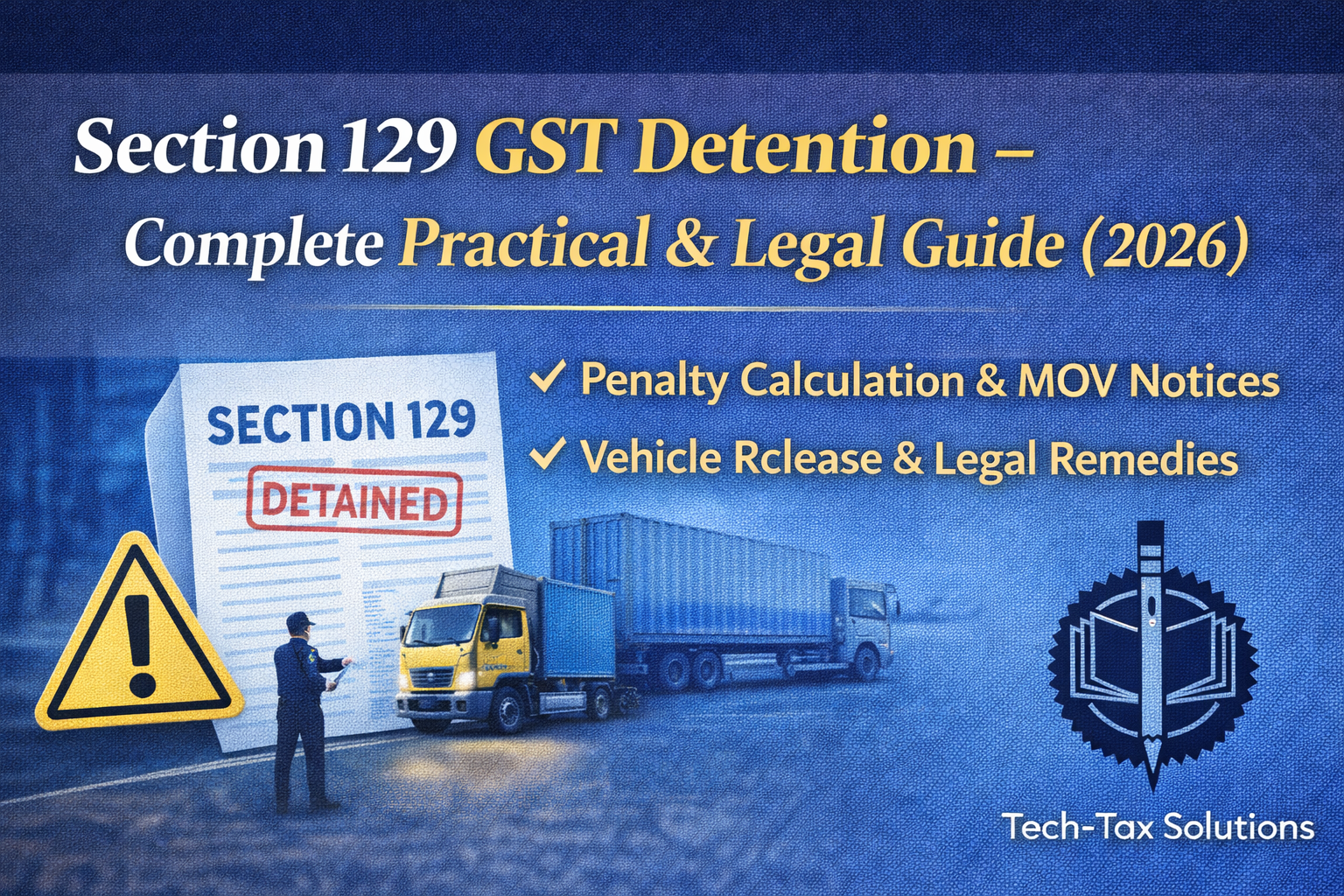
📌 What Is Section 129 of GST?
Section 129 of the CGST Act, 2017 deals with:
Detention, seizure and release of goods and conveyance in transit.
If goods are found moving:
-
Without proper documents
-
With expired E-way bill
-
With mismatch in invoice
-
With suspicion of tax evasion
The officer may detain the goods and vehicle.
🔍 When Can Section 129 Be Invoked?
Common triggers:
-
Expired E-way bill
-
Wrong vehicle number
-
Invoice mismatch
-
Quantity difference
-
No Part-B update
-
Suspicion of undervaluation
However, Section 129 is not meant for minor clerical mistakes.
🧠 Step-by-Step Procedure Under Section 129
When goods are intercepted:
Step 1: MOV-02
Order of detention issued.
Step 2: MOV-06
Tax & penalty calculated.
Step 3: MOV-07
Notice issued asking why penalty should not be imposed.
Step 4: MOV-09
Final order passed.
💰 How Is Penalty Calculated Under Section 129?
Situation Penalty Owner comes forward 200% of tax Owner does not come forward Higher liability
| Situation | Penalty |
|---|---|
| Owner comes forward | 200% of tax |
| Owner does not come forward | Higher liability |
⚠ After amendments, penalty structure is strict, but application must be reasonable.
🧾 Can Goods Be Released Immediately?
Yes, in the following ways:
✔ Payment of tax & penalty
✔ Furnishing bank guarantee
✔ Filing appeal and seeking relief
But immediate payment is not always advisable without legal review.
🧠 3 Practical Scenarios & Solutions
🟢 Scenario 1: Expired E-Way Bill – Genuine Delay
Goods detained due to 4-hour expiry.
Solution:
-
Show toll receipts
-
Explain breakdown
-
Demonstrate tax paid
-
Argue absence of intent
Penalty often reducible.
🟢 Scenario 2: Quantity Minor Difference
Officer finds small variation in weight.
Legal Position:
Minor variation does not equal tax evasion.
Strategy:
-
Reconcile invoice
-
Explain loading variance
-
Seek release with minimal penalty
🟢 Scenario 3: Wrong Vehicle Number Entered
Common clerical mistake.
Defense:
-
Produce correct vehicle details
-
Show no revenue loss
-
Rely on judicial precedents
Often challengeable.
⚖️ Important Judicial Principles
Courts have consistently held:
-
Section 129 cannot be invoked mechanically
-
Intent to evade tax is relevant
-
Procedural lapse ≠ confiscation
-
Proportionality must be maintained
❌ Common Mistakes Businesses Make
-
Paying penalty immediately without reply
-
Ignoring MOV-07 notice
-
Not filing detailed written objection
-
Treating every detention as hopeless
Paying penalty immediately without reply
Ignoring MOV-07 notice
Not filing detailed written objection
Treating every detention as hopeless
Many cases are legally defendable.
📋 Practical Compliance Checklist
✔ Train drivers on document handling
✔ Monitor E-way bill validity
✔ Keep tax invoice updated
✔ Maintain route documentation
✔ Prepare detention response SOP
Prevention reduces litigation cost.
🏁 Final Takeaway
Section 129 is a powerful provision — but it is not absolute.
Proper documentation and timely legal response can significantly reduce exposure.
Detention does not automatically mean tax evasion.
📞 Advisory Note
If goods or vehicles are detained under Section 129, early and structured legal handling often determines the final outcome.





)